|
|
 |
|
|
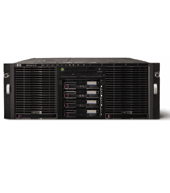
Today's business critical applications
demand ever-increasing scalability and availability from enterprise
servers. Space in enterprise class data centers is becoming increasingly
scarce, driving the requirement for servers that provide maximum
performance per U. The ProLiant DL740, with new Intel Xeon processors MP
at 2.2GHz, 2.7GHz & 3.0GHz, Hot-Plug RAID Memory, and a full
implementation of PCI-X I/O, delivers the performance and uptime required
to meet the current and future demands of enterprise server consolidation,
database, ERP, CRM, mail and messaging, and data mining/warehousing
applications. Based on HP developed F8
architecture, the ProLiant DL740 offers excellent scalability driven by
its balanced system architecture. Capable of supporting up to 8 Intel Xeon
MP processors in an ultra dense 4U form factor, the ProLiant DL740 saves
critical space in the data center, making it an ideal clustering and
server consolidation platform. |
|
|
|
|
|
|
|
|
Models
- 4P 3.0GHz-4MB cache, 4GB RAM
- 4P 2.7GHz-2MB cache, 4GB RAM
- 4P 2.2GHz-2MB cache, 2GB RAM
Performance
- Larger cache sizes including the new 4MB cache offer enhanced
performance for cache-intensive database deployments (OLAP & OLTP)
Specs
at a glance
| |
DL740 |
| Processor |
Intel® Xeon™ processor MP at 3.0GHz, 4M
cache (up to 8 supported),
400 MHz FSB |
| Standard Memory |
4 GB |
| Max Memory |
64 GB |
| Max Internal Drives |
4 |
| Tower |
n/a |
| Rack |
4U |
|
|
|
|
|
|
Enterprise Growth - Enterprise
customers using Windows servers for horizontal applications such as
Database, Messaging, ERP, or CRM may have outgrown their current platform.
Customers who desire to consolidate their servers or applications or
manage their workload better.
Problems and Requirements
Many organizations have
implemented Windows-based servers to support their functional needs for
database services, messaging, infrastructure, business applications, and
e-commerce. As these environments grow and become more critical to the
organization the need for performance and availability increases. Needs
include:
- 24×7 availability and scalability is required in data center
environments with enterprise applications requiring large internal and
external storage
- Servers need to support more users and/or provide faster response
time for existing users
- Supporting and managing larger workloads using a smaller number of
more powerful servers
Typical Use
- OLTP Database Servers supporting Windows applications -- either
internally written applications or as the database server for a 3-tier
application such as SAP, PeopleSoft, JD Edwards, Siebel, etc.
- Consolidated-tier environments for SAP, PeopleSoft, JD Edwards,
Siebel
- Exchange 2000 and Lotus Domino enterprise messaging environments
- Collaboration tools - Lotus SameTime and QuickPlace
- Data Warehouse, Large Data Marts, or Business Intelligence systems
- Server Consolidation and workload management
Move
from Proprietary to Industry Standard Technology
Problems and Requirements
Organizations who want
to implement a highly available Windows or Linux -based solution as an
alternative to a proprietary UNIX deployment.
- Want an alternative to an expensive proprietary RISC/UNIX solution
but with the same service levels
- Need to combine the predictability of the traditional glass house
with the flexibility of Industry Standard technology
- Want to integrate a proven, reliable Windows or Linux platform
into the corporate data center-quickly and easily, including mixing
Windows and Linux on the same server
Typical Use
- Database Server running Microsoft SQL Server with Windows 2000 or
Windows 2003
- Database Server running Oracle with Linux operating system
- OLTP Database Servers supporting Windows or Linux applications --
either internally written applications or as the database server for a
3-tier application such as SAP, PeopleSoft, JD Edwards, Siebel, etc.
- Single tier environments for SAP, PeopleSoft, JD Edwards, Siebel
- Data Warehouse, Large Data Marts, or Business Intelligence systems
- Processing or data servers for eCommerce environments
- Exchange 2000 and Lotus Domino enterprise messaging environments
- Server Consolidation and workload management
Solving
the Customer Problem
- Industry standard servers and Microsoft SQL Server are accepted as
cost-effective platforms for enterprise level database transaction and
data warehouse environments. The ProLiant DL740 is a powerful platform
for new applications that in the past would have been deployed on
expensive, proprietary platforms in the past. The DL740 is a
performance upgrade to Windows-based servers that, due to growth, are
no longer supporting the needs of the organization.
- Unisys has been selling their ES-7000 as the only option
available for applications that have grown beyond the capabilities
of an 8-processor system. With the DL740 and the HP Itanium Platform Family, HP now offers a growth part for those
customers and an option that is more reliable and less-expensive
than the niche Unisys product line.
- Customers that are looking to migrate their proprietary database
and enterprise application implementations to industry standard
hardware should definitely consider the ProLiant DL740.
- Oracle database and applications software running on the Linux
operating environment when combined with the DL740 can provide
customers with a powerful new platform. With twice the performance and
four times the memory of the ProLiant DL760 and ProLiant 8500, the
price performance of this server offers customers a cost effective
alternative to expensive, proprietary platforms with the investment
protection that comes from industry standards.
- Enterprises deploying large SAP R3 implementations or compute
intensive Business Warehouse applications on industry standard servers
require the highest levels of system performance, reliability and
availability. The DL 740 provides a powerful platform for new and
existing customers to deploy these key SAP applications and provides
the ability to support incremental users. The DL740 features:
- Additional reliability and availability including hot-add memory
which will allow the addition of memory during time of peak usage
without re-booting the system.
- Improved performance
- A more powerful server that, when combined with HP Resource Partitioning Manager (through
Workload Management Pack) and customized HP VMware solutions and services, can be
used to consolidate multiple applications onto a single server.
Server Consolidation
Problems and Requirements
Customers running an
application (e.g. Microsoft SQL Server) on multiple servers either
distributed throughout the company or in a centralized data center want
reduce their server count and consolidate on fewer, more powerful
industry-standard servers. This move will enable them to take advantage
of an industry-standard server platform with the highest level of
performance AND availability.
- Need to run multiple workloads with the highest possible levels of
availability
- Need simplified management by decreasing the number of servers for
the specific application environment
- Need convenient and quick deployment with little to no guesswork
- Need assistance in assessing the business value, cost savings, and
requirements of server consolidation
- Need a chassis design with the flexibility to add options as
needed but not compromise on serviceability
- Need to leverage investment in existing HP 8-way servers
Typical
Use
- Consolidation of multiple servers and applications
- Development, testing and qualification environments where
switching between various SW platforms is desired
- Domino servers supporting multiple Domino partitions of several
thousand users each
- Domino clustering provides data replication to support
high-availability
- Consolidation of Microsoft Exchange back-end mailbox server,
public folder, free-busy server, content indexing and messaging
tracking roles, along with virus checking, management, spam filtering,
and backup/restore agents
- File and print serving
Solving the Customer Problem
- Enabling customers to partition the server for multiple
applications using ProLiant Essentials Workload Management Pack's
Resource Partitioning Manager capability (e.g. the Exchange 2000 STORE
process, which handles messaging traffic, is granted a dedicated
allotment of processors and memory, while the other services and
agents found on a typical messaging server deployment are limited to
the remaining processors. The results, in testing, have been improved
scalability and response times.)
- Enabling customers to run many 'virtual servers' by supporting
multiple or even different instances of the O/S or application through
the use of VMware ESX or GSX Server products. (e.g. multiple and
separate instances of Citrix MetaFrame servers running on the same
server).
|
|
|
|
|
|
|
 |
» DL760 G2 |
DL740 |
| Processor |
2.2GHz, 2.7GHz, or 3.0GHz Xeon MP |
2.2GHz, 2.7GHz, or 3.0GHz Xeon MP |
| Processor Cache |
2MB (2.2 GHz and 2.7 GHz) or 4MB (3.0 GHz) L3 |
2MB (2.2 GHz and 2.7 GHz) or 4MB (3.0 GHz) L3 |
| MP |
8P capable (populated in groups of 4) |
8P capable (populated in groups of 4) |
| Front Side Bus |
400MHz |
400MHz |
| Chipset |
F8 |
F8 |
| Memory |
133MHz SDRAM |
133MHz SDRAM |
| Advanced Memory Protection |
Hot Plug RAID Memory (Front Access) |
Hot Plug RAID Memory (Top Access) |
| RAM Std/Max Addressable (Total) |
2GB OR 4GB/64GB (80GB) |
2GB OR 4GB/64GB (80GB) |
| Drive controller |
Smart Array 5i |
Smart Array 5i |
| NIC |
Integrated HP NC7170 Dual-Port
PCI-X 1000T Gigabit Server Adapter in a slot |
Dual port PCI-X integrated (10/100/1000) |
| Hard Drive Bays |
4 - 1.0" |
4 - 1.0" |
| Slots (All Hot Plug) |
10 - 64bit/100MHz PCI-X
1 - 64bit/33MHz |
6 - 64bit/100MHz PCI-X |
| Chassis |
7U modular |
4U modular |
| Remote Server mgmt |
Remote Insight Light-Out Edition II (optional) |
Integrated Lights Out Standard (iLO) |
| Power |
Two 1150/500 Watt Hot Plug Redundant Power Supplies Standard |
Two 1100/800 Watt Hot Plug Redundant Power Supplies
Standard |
|




