|
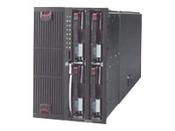
The ProLiant BL p-Class system is part of the ProLiant BL servers and
infrastructure portfolio developed for adaptive computing and optimized
for rapid deployment and automated provisioning. The ProLiant BL p Class
system provides high performance, high availability server blades for
multi-tiered data center architectures.
The ProLiant BL p-class system enables dynamic scaling and protects
your investment with an intelligent, modular infrastructure that can
accommodate future server blades. The first 4-way server blade in the
ProLiant BL p-Class family is the BL40p, engineered for the back-end
enterprise space. This server blade features up to four Xeon MP 2.0GHz/1M,
2.2GHz/2M, 2.8GHz/2M and 3.0GHz/4M processors, PC2100 ECC SDRAM (12GB max
memory w/ online spare), Integrated Smart Array 5i Plus (with optional
BBWC) and four hot-plug SCSI drives.
Using the ProLiant BL40p in conjunction with other BL servers, expenses
can be reduced by managing remotely from anywhere in the world with the
advanced version of Integrated Lights Out (iLO). In addition, an
integrated management system and full compatibility with the Insight
Manager™ Suite gives you maximum virtual presence and control, management
and health monitoring with blade visualization of all your
applications. |
 |
|
What's new |
|
|
- Features up to four Xeon MP 2.2GHz/2M and 3.0GHz/4M processors,
PC2100 ECC SDRAM (12GB max memory w/ online spare), Integrated Smart
Array 5i Plus (with optional BBWC) and four hot-plug SCSI drives
- New I/O cable with two USB ports, one video port, one iLO port and
kernel debug port. The I/O cable attaches to the front of the server
blade on the 3.0GHz and 2.2GHz models of the BL40p. The cable was
specifically designed to aid in initial server image deployment
|
|
Ideal environment |
|
|
Ideal for...
Large corporate datacenters
- Corporate enterprise and service provider data center environments
with back-end server needs which require rapid scalability
- Customers requiring an enterprise-class 4-way server that
complements their 2P blade server deployment and that delivers maximum
performance and availability for business critical applications
Typical UseThe ProLiant BL40p server blade would
typically be used for:
- Medium to large enterprise databases
- Messaging and collaboration
- IPC Clustering / Failover Clustering
- Environment that requires significant computational power in a
dense form factor
- Application servers
- Database Servers
- Internet business (e-commerce) Server consolidation
- "e-business" (eCommerce, web hosting)
- Server consolidation
- Enterprise Resource Planning (ERP)
- Customer Relationship Management (CRM)
- Data Warehousing
- Large file/print or domain controllers
Customer Problem
- Environments are changing rapidly - need to be able to scale
quickly with customer base
- Rack space is limited - need to do more with less space
- Scarce IT resources and increased cost pressures require solutions
that are simple to install and manage
- As servers get smaller, cabling problems increase. Need a way to
reduce the number of cables in the data center
- Scarce IT resources require solutions that are simple to install
and manage
- Require remote management tools to control servers around the
world
- Require redundant solution Require highly available and
serviceable solution
Solving the Customer Problem
- Customers implementing enterprise clusters using Oracle 9i and
Real Application Clusters on Microsoft Windows and Linux can utilize
the BL40p in conjunction with NSPoF SAN as a reliable and cost
effective, highly available and scalable solution for mission critical
database applications. Fully redundant and optimized BL40p blades and
other highly reliable, industry standard hardware provides
significantly improved uptime and lower operating costs than multiple
single-server or proprietary database implementations. In the event of
a failure anywhere in the cluster, the remaining nodes can continue to
access the database, ensuring high availability for the most critical
applications.
The use of the ProLiant BL40p also provides:
- Ease of Management and better utilization of hardware resources
with the ability to add or reduce nodes to the cluster in a quicker
manner as the workload requirements change
- With multiple database applications resident on multiple
servers, customers can achieve economies by physically consolidating
their database and applications in a single location
- Better overall management of the database server environment to
reduce demand on expensive Database Administrator resources
- With introduction of the ProLiant BL40p and BL20p G2 blade
servers, large SAP customers are now able to implement a fully
functional SAP environment including database and application servers
within a single rack. The ProLiant BL40p has the CPU Power and memory
required to serve as a fully functional database server and drive a
rack full of ProLiant BL20p G2 application servers. The PCI slots
available in the ProLiant BL40p allow a wide range of adapters to be
used to connect needed storage to the blades. This solution offers
customers both a cost effective and space saving solution for full
deployment of their SAP application landscape.
The BL40p
provides SAP customers:
- enhanced resource management
- the capability to dynamically reconfigure system resources as
needs
- improved efficiency and performance
- ability to support an increased number of users within a single
rack configuration
- Increased cost pressures and scarce skilled IT resources are
causing more and more IT departments to implement enterprise wide
terminal server solutions utilizing Citrix MetaFrame XP. A cost
effective enterprise wide solution requires SAN connectivity with
back-end servers, which are highly available, can rapidly scale
horizontally and are simple to manage. The ProLiant BL40p server
blades are ideal for this infrastructure providing a cost-effective
solution that is highly available and rapidly scales with ease of
manageability.
The ProLiant BL40p utilized in terminal server
farms provides:
- Horizontal scalability, distributing the risk and load to impact
the least amount of users at any one time
- The performance necessary to support more compute intensive
line-of-business custom and legacy applications in a multi-tiered
terminal server environment
- Rapid and dynamic deployments provide faster time-to-solution
and quicker time to respond to changing business needs
- Integrated Lights-Out (iLO) remote connectivity provides
anywhere, anytime access to management of terminal server farm
- A powerful Internet Business solution built on flexible,
high-performance and highly scalable Internet architecture is what is
demanded in today's e-commerce environment.
As part of this
flexible architecture the ProLiant BL p-Class blades:
- Deliver outstanding performance, manageability, scalability in a
compact rack design, while reducing cabling issues
- Provide an optimum platform for the web application layer in a
Microsoft multi-tired e-commerce environment
- Provide the flexibility to make it easy to rapidly scale out
Microsoft Commerce Server or Microsoft Content Management Server
applications as your demand grows
- Enterprise messaging environments built around Microsoft Exchange
and Lotus Domino are leveraging multi-tiered architectures and greater
SMP scaling efficiencies of today's more powerful servers that
facilitate the consolidation of mail accounts, simplifying management
and reducing licensing and administrative costs. Additionally, they
are undergoing rapid change with the embracing of native internet
client and integration of mobile device support. These new access
points require additional edge-of-the network servers which may
support several physically distributed sites dictating redundancy,
rapid scalability, and manageability requirements.
The
ProLiant BL p-Class servers fit well into this environment enabling
the messaging environment to scale quickly and easily, as the user
population access needs changes. The ProLiant BL40p servers can be
utilized in the following messaging roles:
- Exchange 2000 back-end messaging servers, connected to SANs,
supporting several thousand active users, or multi-roled Exchange
servers (consolidating both front-end and back-end roles on the same
server)
- Exchange front-end servers for OWA (Outlook Web Access) for the
largest of web-user populations and for SSL-enabled users
- Domino servers supporting multiple Domino partitions of several
thousand POP3, IMAP4, iNotes, or HTTP users each Domino clustering
to provide
- Domino clustering provides data replication to support
high-availability
- Complete wireless application gateway infrastructures which
enable mobile workers using PDA's to access their e-mail in
real-time and synchronize email and PIM data for offline access
- Mobile enterprise print servers which enable printing from
mobile e-mail devices
- Customers are implementing multiple data marts to support the
business units by utilizing the cost-effective business intelligence
features of Microsoft SQL Server such as included data mining
algorithms, Online Analytical Processing (OLAP), and Data
Transformation Services. These data marts may pull data from
production systems (stand-alone) or from a data warehouse (federated
data marts). Data marts proliferate as business units need unique
access to different combinations of production data.
The use
of BL40p for data mart usage provides:
- Cost-effective hardware platforms for data marts
- Ease of Management
- Performance to build cubes and support queries
- Better utilization of hardware resources through the deployment
of new data marts in a quicker manner
- Customers with multiple Microsoft SQL Server database applications
resident on multiple servers can achieve economies by physically
consolidating their database applications in a single location. The
use of BL40p for physical database consolidation allows for the
following:
- Better sharing of storage resources by moving from a direct
attached environment to a SAN environment can result in a reduction
of overall storage costs.
- For smaller database applications a movement to SQL Server
Enterprise Edition with support for multiple instances on the same
server can result in a reduction of server headcount with a
resulting reduction of software licensing fees. Note that the
combination of multiple database and application on a server
requires an analysis of workload better overall management of the
database server environment to reduce demand on expensive Database
Administrator resources.
|
|




